
MARTINGALE METHOD
AND THE THEORY OF PROBABILITY IN TRADING
The Maptingale strategy is very popular among a certain group of traders, but at the same time one of the most controversial. The attitude towards it divides the trading community into those who are confident in its effectiveness and those who absolutely do not accept this style of trading, considering it too aggressive and adventurous, bringing stock trading closer to gambling. However, the reality is that this strategy is used by some traders, and a large number of automated trading systems have been developed based on it. So what is a martingale? The origin of this term is unknown; there are various versions. The first mention of a martingale is in the phrase "D'Alembert martingale" and dates back to the mid-18th century. It is associated with the name of the renowned French mathematician Jean Le Rond d'Alambert, the author of works on the theory of numerical series and differential equations. He is known to have provided the first proof of the fundamental algebraic equation. Although there is no official information linking him to the Martingale system, some sources associate his name with it. Another theory holds that the name derives from the slang term for card players "la martingale," which literally meant "to play in an absurd manner," a description of the game of one successful French player. The first official reports about Maptingale are related to the casino, in particular, to the game of roulette. Martingale is a gaming system in which each losing bet was doubled, which allowed the first win to cover the loss and make a profit. The method is based on the theory of mathematical expectation. The point is that the winnings cover the amount of all previous losses.
Probability Theory in Financial Market Trading
The Martingale strategy has a fairly simple logic for event probability: the positive and negative outcome of a trade is equal to 50%. The theory of probability in financial market trading is as follows: in each trade, a trader has an equal chance of making a profit or losing. The Martingale trading system is based on the assumption that there can't be 100% losing trades. Even several consecutive losses will, sooner or later, be followed by a profit. A trader's primary goal is to properly calculate the potential of their deposit so as to achieve a profit without losing all of their funds. When choosing this strategy, a trader is better off testing it first and only then trading on a real account. It's important to note that there are also automated programs that use the Martingale principle.
Mathematical trading strategies
The Martingale system assumes that not all trades can be losing, and that the mathematical expectation of a profitable trade increases geometrically after each subsequent loss. For a situation where a trader is risking real money, the rationale is rather murky, isn't it? Proponents of the system claim that with proper market analysis, combined with strict adherence to capital management rules, a working strategy can be developed. Not all brokers share their optimism and allow trading with this system, considering it too risky. Therefore, a trader who still intends to trade using Maptingale must first find out whether this type of trading is allowed at this particular broker in order to avoid penalties. Mathematical expectation in practical application helps a trader to control his trading. For this it is necessary to keep statistics. Let’s assume that for the selected time period the ratio of profitable and unprofitable trades is 40/50. At the same time, the probability of a series of two profitable transactions is equal to 40%x40% or 0.4x0.4 = 0.16 (16%). Three successful trades in a row have a lower probability - 0.4x0.4x0.4 = 0.064 (6%). Probability of two losses 0.5x0.5 = 0.25 (25%). Three losses in a row = 0.5 x 0.5 x 0.5 = 0.125 (12.5%). Clearly, each losing trade reduces the expectation of the next loss and increases the chance of making a profit, and vice versa.
The Martingale System in Trading
Traders who use the Martingale strategy adhere to the following rules: - the initial bet should be minimal; - after the first profitable trade, it is imperative to return to the size of the first bet; - Strictly and strictly adhere to risk and money management rules, as the number of consecutive losing trades can be quite large. The minimum bet should not exceed 1% of the deposit. - The strategy is best applied during a pronounced trend movement; in a flat market, the Martingale strategy is fraught with too large losses.
Use on Forex, formula
The Maptingale system on Forex works as follows. After each losing trade, the volume of the next position doubles. If the first deal was opened with a volume of one lot and it turned out to be unprofitable, the second deal is opened with a volume of 2 lots, the third - 4 lots, the fourth - 8 lots, etc. That is The Martingale formula looks like this: Q = q2n-1, where q is the position volume in the first trade, n is the trade number. Q is the position volume. Question: "What size of deposit should I have to withstand four losing trades in a row?" Or more? Here, it is imperative to adhere to risk and capital management principles. You can learn about risk management and money management strategies on the page. On Forex, trading according to this system looks like this. For example, the first buy trade is opened with a size of 1 lot, a stop-loss of 10 pips, and a take-profit of 10 pips. The price falls by 10 pips, and the trader loses $10. The next trade is opened with a size of 2 lots. The price moves in favor of the trade—the profit on the second trade is $20, the loss on the first is $10, for a total profit of $10. The profit is always equal to the value of the first trade. In practice, using this strategy is associated with high risks. To withstand a significant series of losses, a large deposit is needed, because the trade volume grows geometrically in the event of an unsuccessful trade. To achieve this, it's necessary to control the parameters of acceptable risk. There are less aggressive versions of the Martingale trading strategy. Each subsequent trade isn't doubled, but rather multiplied by a factor (for example, 1.2 or 1.5). Proponents of this method claim that the strategy is win-win if capital and risk management principles are strictly followed.
Simple strategies on Forex
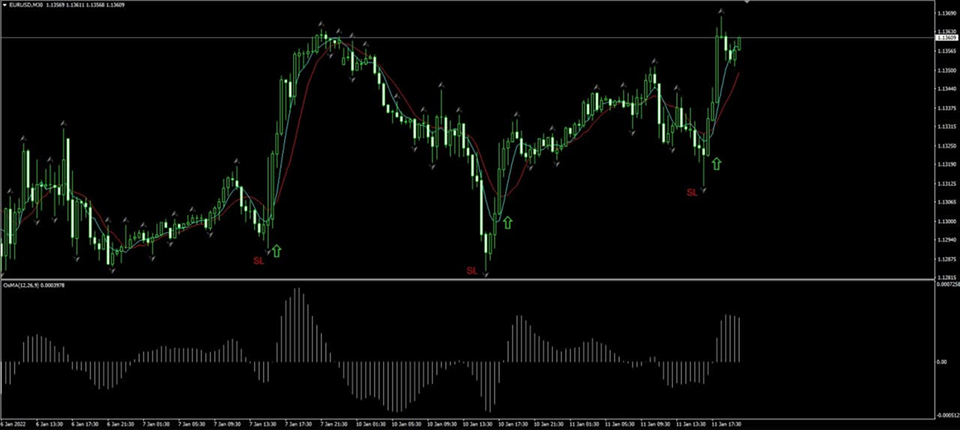
Simple template - buy signals
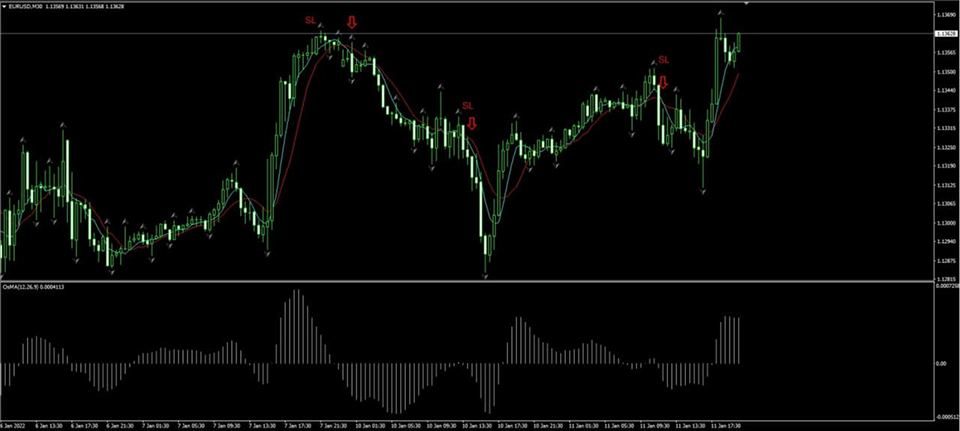
The sell signal is the opposite
A variation of the Martingale method is the averaging strategy. Many traders use it as a way to minimize losses. The logic behind the averaging method is as follows. Suppose a trader opens a buy trade. However, the price reverses and moves in the opposite direction. The classic advice for minimizing losses is to place a wise stop-loss. But the trader is confident that he has correctly assessed the market situation and that the price will go up, so he is absolutely unwilling to suffer a loss, even a small one. After some time, when the price slows down, hope arises that a reversal will occur and justice will prevail. At this point, a new buy trade is opened with the same volume. It's possible the price will still go up. In this case, it will reach a level where the profit from the second trade equals the loss from the first trade. At this point, the trade can be closed. The result will be zero, but the loss was avoided. But this is the simplest case. The price may move in the opposite direction for quite a long time, and the trader will open more than one trade, waiting for a reversal. Theoretically, the price will eventually reverse in the desired direction. The question is, will the deposit withstand the accumulated losses? There are many options for using the averaging method: - subsequent trades can be opened with an increased volume, then in case of a reversal there is a chance not only to cover the loss, but also to make a profit; - trades can be opened based on the market situation - at important levels, according to signals of reversal patterns; - You can place limit orders at a certain number of points; the averaging strategy is aggressive and exposes the trader's capital to greater risk. It is much more profitable to use this strategy on profitable trades. When the price moves in the direction of the open order, positions can be added after a certain period of time. In the event of a reversal, the deal will close, in the worst case, at breakeven, in the best case, it will increase profits.