
TRADING ON FLASHBACKS - EARNING STRATEGIES
Most short-term traders try to close their positions before major news releases due to the increased risks associated with high volatility. On the other hand, there are traders who utilize this factor in their trading strategies. The selection of instruments for intraday trading is particularly important and has a direct impact on results. You can use the most effective strategies and adhere to risk and capital management principles, but still achieve no results. The cause may be an incorrect choice of instrument. And this is equally true for all markets. Whether it's currency pairs, stocks, or futures, the choice should provide potential profit opportunities. The instrument must be mobile and liquid, otherwise it will be difficult to enter or exit a trade at the desired price; this factor is very important for intraday trading. Trading on news allows you to identify where to expect a move with good potential. Whether it's a currency pair, a stock, an oil futures contract, or a stock index isn't so important. The "how to trade the news" strategy is based on selecting instruments for which important information is published that could cause increased volatility. This approach narrows the search horizon to those assets that are newsworthy and likely to trigger a corresponding market reaction. News can vary in nature and market impact. Investors pay attention to the following: the publication of macroeconomic indicators; important political news; corporate reporting; management changes; and more. Different tools react to different news and the degree of reaction is also very different. In addition to the predicted standard messages, there are many events happening in the world that can cause a real commotion in the financial world and cause excitement and panic on the stock exchanges. This group of news includes: natural disasters; technogenic disasters; Events involving influential figures in the worlds of business or politics. Market participants are people who, in a given situation, rely on knowledge, experience, fear, despair, apprehension, or hope. In 2020, experts noted that market participants often relied more on expectations than on specific figures, and sometimes fears were more significant than facts. Therefore, news trading is considered very risky.
News and stock exchanges, facts and comments
The stock market, like a mirror, reflects any events and processes that take place in the world. 2020 was a unique year for stock exchanges in many ways - from the most abrupt and powerful collapse - to a record-breaking recovery, and then surprised with the update of new peaks and fixation of new historical maximums. The interweaving of news of various contents was immediately reflected in market reports. In February 2020, the COVID19 pandemic triggered a stock market crash. The deterioration of the epidemiological situation in European countries led to the announcement of quarantine restrictions in various regions - first in individual areas, then in entire regions countries On February 20, a downward correction began on the exchanges. From February 24 to 28, world stock indices had their largest weekly decline since the financial crisis of 2007-2008. The markets met the beginning of March with extremely high volatility with fluctuations of 3% or more per session. The general situation was tense. It was becoming clear that there was no quick solution to the COVID-19 problem. The Organization of Petroleum Exporting Countries (OPEC) discussed possible temporary production cuts to offset the loss of demand amid global economic lockdowns. On March 5, the cartel initiated a 1.5 million barrels per day oil production cut. This would have allowed production to reach its lowest level since the Iraq War. On March 6, disagreements arose between OPEC and Russia, and on March 7, Saudi Arabia and Russia unexpectedly announced production increases. Oil prices collapsed by 25%. On March 8, Saudi Arabia unexpectedly announced it would increase crude oil production and sell it at a discount to buyers in Asia, the United States, and Europe. The largest discounts were intended for Russian oil consumers in Europe. Following this, on March 9, prices plummeted by another 30%. West Texas Intermediate crude oil fell to its lowest level since February 2016, while Brent suffered its biggest drop since the 1991 Gulf War. On March 9, US President Donald Trump announced a 30-day travel ban from the Schengen area. Immediately after the opening, American indices fell more than 7%, triggering a temporary trading halt. The Dow Jones Industrial Average lost more than 2,000 points. News International called it "the biggest drop in intraday trading history." Investors dubbed the day "Black Monday." Shares of oil giants suffered the most, with Chevron and ExxonMobil falling more than 15%. The NASDAQ Composite and S&P 500 lost 7.3% and 7.6%, respectively. The VIX CBOE “panic” index jumped by 30%. On March 11, the WHO declared a pandemic. March 12 went down in history as “Black Thursday.” Immediately at the opening of the American stock exchanges, a dizzying drop led to an emergency stop of trading. The fall in indices exceeded 9% - DJIA -9.99%, S&P 500 -10.64%, Nasdaq -9.43%.
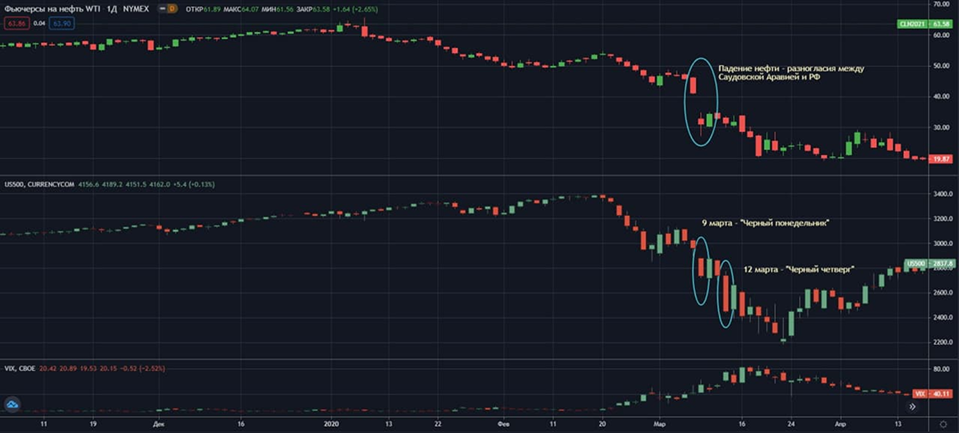
Oil, the S&P 500, and the VIX in March 2020
Forex News Trading
The news trading strategy is quite popular among Forex traders, despite being considered aggressive and high-risk, as it involves strong and unpredictable price movements. Markets react to the release of important economic data released by official institutions and organizations. Almost all broker websites and reputable publications post an economic calendar on their pages. The calendar contains information about the time of publication of the most significant macroeconomic indicators, indicates the previous value and forecast. This complex of data allows you to see the situation over time and compare it with the estimates of experts and analysts. Investors are most interested in data on unemployment, inflation, GDP, changes in the key interest rate, speeches by central bank representatives on the fundamentals of monetary policy, and indicators of industrial activity. The most significant news in terms of its impact on market activity is the publication of data on changes in the number of people employed outside the US farm sector – Nonfarm Payrolls. The number of new jobs created in industries that contribute the most to GDP is a very important indicator of the state of the economy. In the seconds following the release of Bureau of Labor Statistics data, currency pairs involving the U.S. dollar can soar or collapse. This offers the potential for huge profits or catastrophic losses, even with a protective stop, gap, or slippage. HOW
Trading the news correctly
Any instruments linked to the published indicator are suitable for this strategy. Major currency pairs react to statistics from the US, EU, UK, Australia, New Zealand, and Japan. The weak nonfarm payrolls report on May 7, 2021, came as a major surprise to traders. While expecting almost a million new jobs, their number reached only 266 thousand. As a result, the dollar index fell significantly against the basket of major currencies.
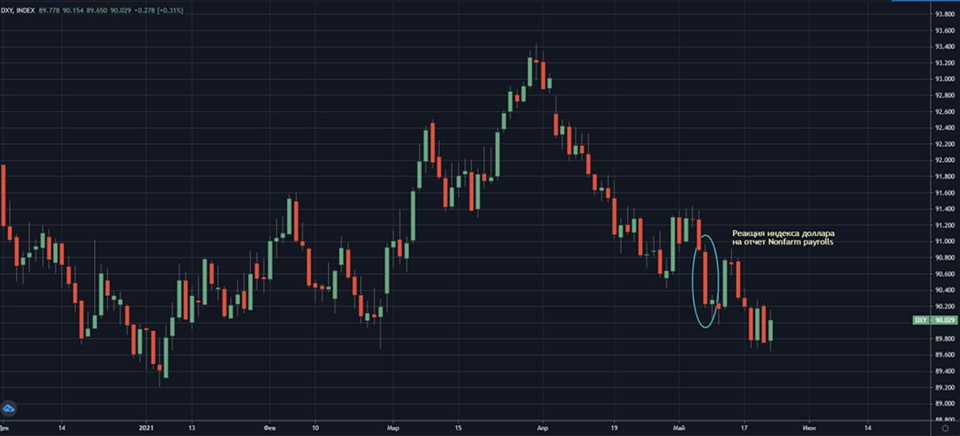
Dollar index on the Nonfarm Pourrolls publication May 7, 2021
The five-minute chart of EURUSD shows a great opportunity to buy above the psychological level of 1.2070. The pair has surged 60 pips in 15 minutes, offering a good opportunity to lock in profits.
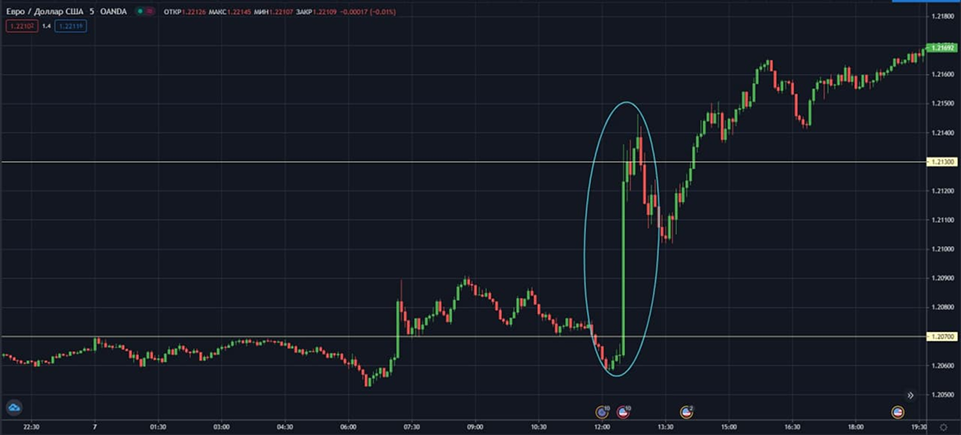
EURUSD, 5 min
Similar situations can be seen on the charts of other currencies paired with the US dollar.
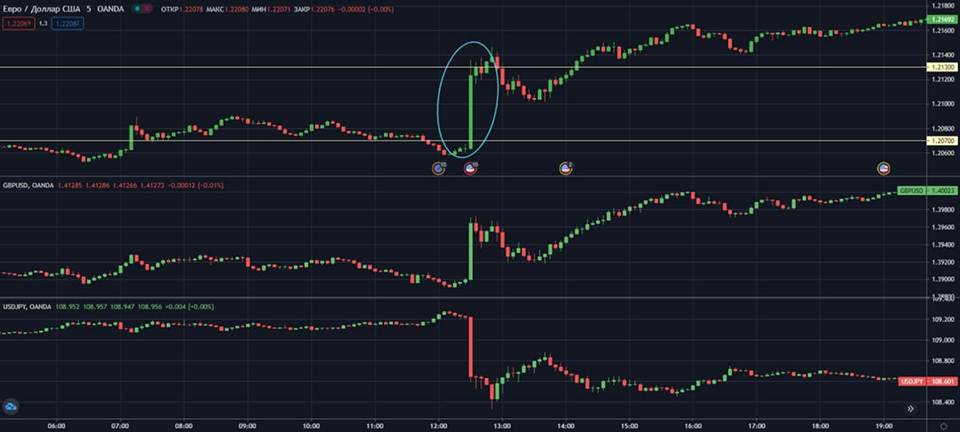
EURUSD, GBPUSD, USDJPY
Quotations of gold and silver may demonstrate strong dynamics in response to the movement of the dollar, as well as news from countries oriented towards the export of raw materials. Examples of very strong market reactions to news include the fall of the Mexican peso against the US dollar after Trump's victory in the 2016 election and the fall of the British pound after the June 2016 Brexit referendum on Britain's membership in the EU.
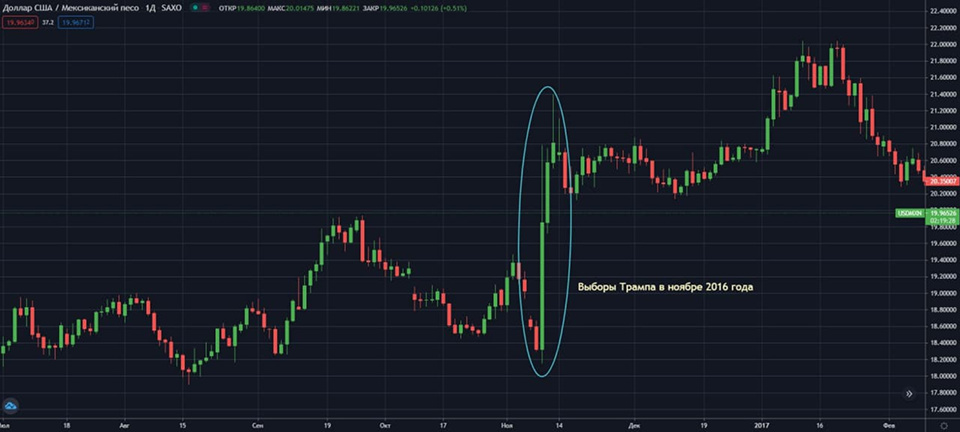
USDMXN
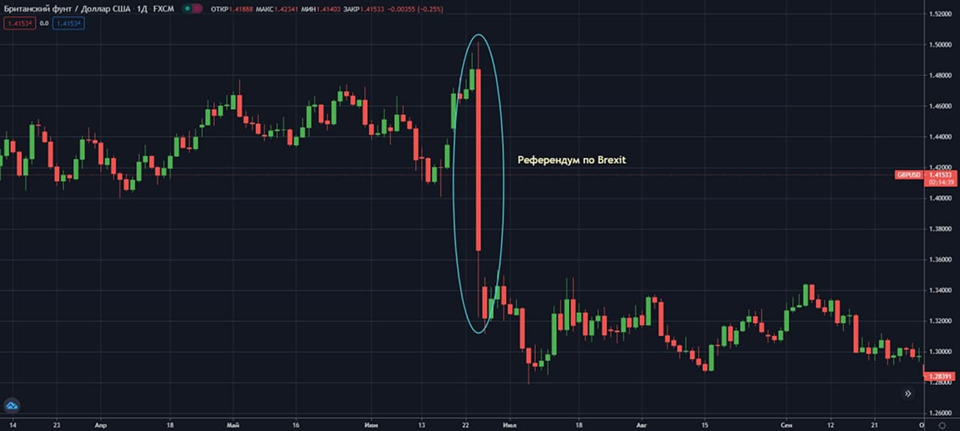
How to make money on news
When considering how to trade news correctly, many traders open trades using pending orders immediately before the news is released. In the West, this strategy is known as "Straddle Trade." Buy-Stop and Sell-Stop orders are placed 20-25 pips away from the current price. Protective stoppers are immediately installed at a minimum distance. Take-Profit is set depending on the instrument. After one of the pending orders is triggered, the second order is immediately deleted. If the market reaction to the news is very weak, then the orders are deleted. Another, less risky option is to enter a trade after the initial market reaction, when price movement has calmed down slightly. The price change is typically instantaneous and very strong. Once the first wave subsides and it becomes clear that prices aren't rushing in the opposite direction at the speed of a steam locomotive, you can open a trade in the same direction. Often, after the first, strongest impulse, the price pulls back slightly, remains flat for a while, and then continues moving.
Trading stocks on the news
Let's also talk about the concept of news trading. At the end of each quarter and at the end of the year, corporations publish financial reports on their operating results. Corporate reporting season is a busy time for traders. Investors closely monitor revenue figures, profits, company forecasts for future periods, dividend announcements, mergers and acquisitions, and other data when deciding whether to buy or sell an asset. For a day trader, whether the news is good or bad doesn't matter; the main thing is that there's a reaction. Most often, reports are published before or after the main session, so traders monitor stock movements in the after-market or pre-market. If a security's price has changed significantly before the main session—by at least 3%—then interest in that stock will be heightened. While preparing for the trading day, the trader identifies important technical levels of support and resistance, the direction of the global and local trend. Taking into account the technical picture and forecast, he compiles probable scenarios for the behavior of the asset price and his actions under possible scenarios. Many traders trade stocks not on the day of earnings releases, but in the days following, distancing themselves from the period of highest volatility and preferring a calmer and more predictable market reaction. Traders who followed Shopifu's quarterly report had a good opportunity. The company released a very strong report before the market opened. Five minutes after trading began, the stock had risen more than 10%.
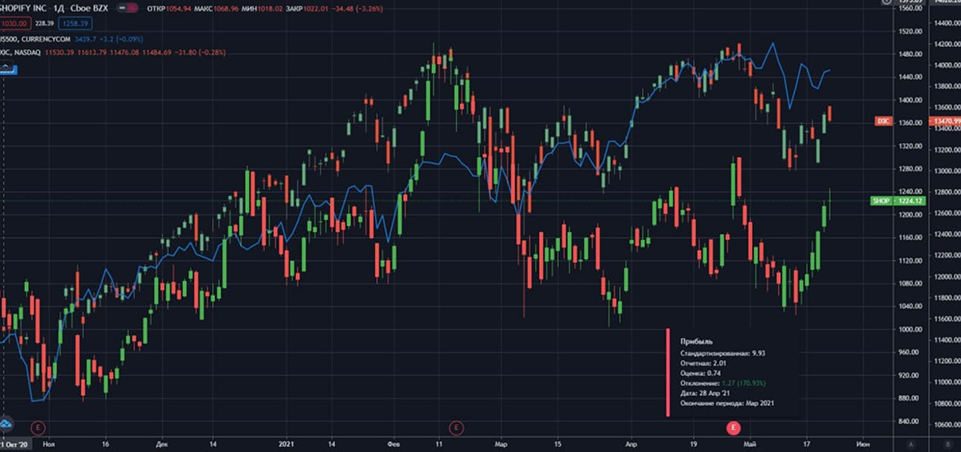
SHOP, D
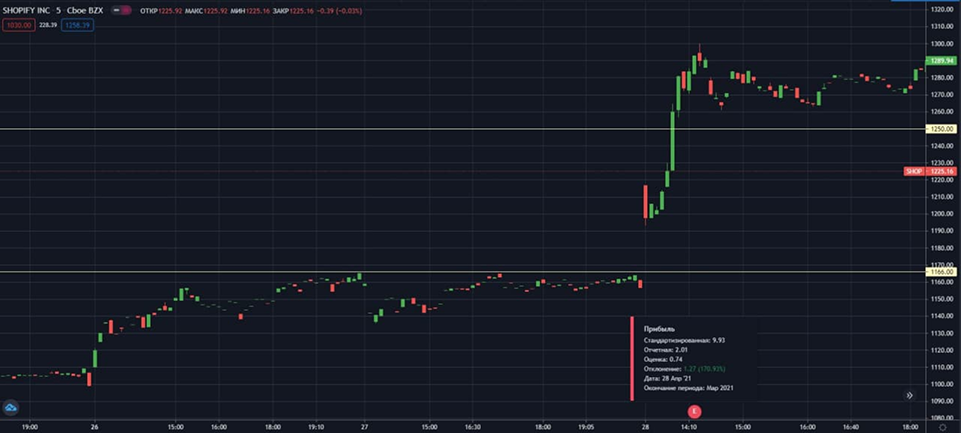
SHOP, 5 min
On earnings day, SHOP rose 11.4%. Snap Inc.'s strong earnings report in October 2020 provided traders with plenty of trading opportunities.
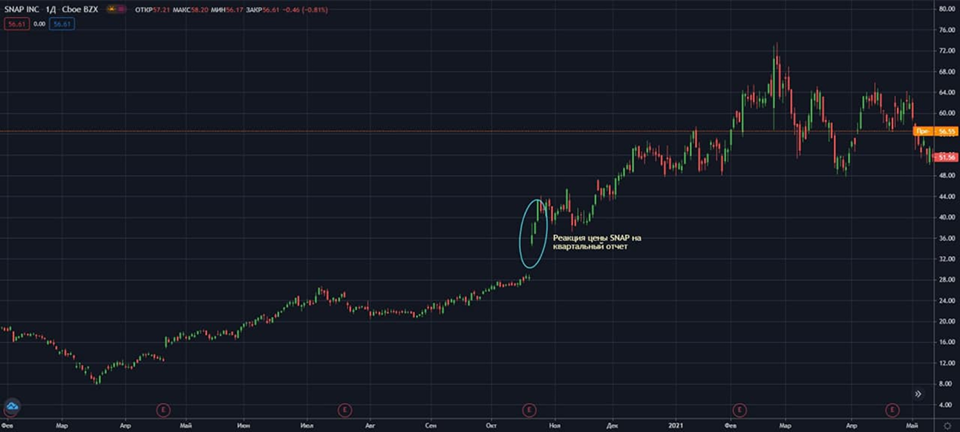
SNAP, D
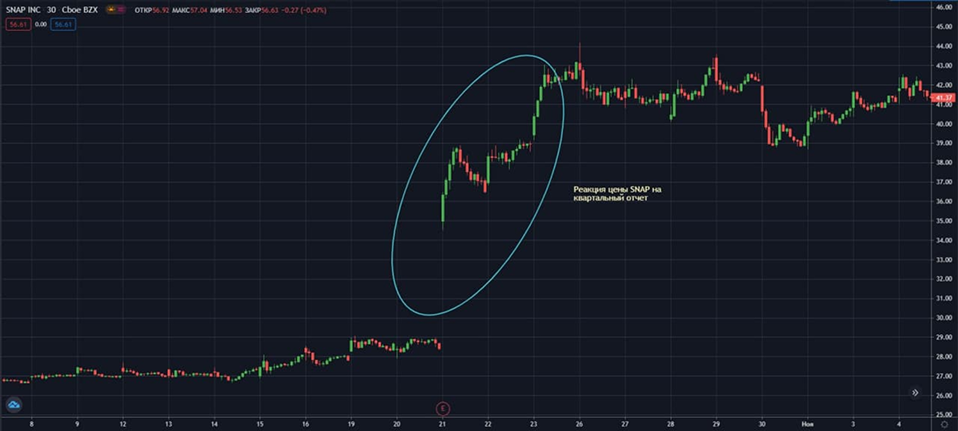
SNAP, З0 min
Conclusions
Using the news background in trading is not a panacea or a magic grail, but simply one strategy among many. It has many peculiarities that must be taken into account. Unfortunately, a large number of novice traders are rather careless about developing a clear strategy and act ad hoc, as events unfold, which often results in loss. This is especially true for Forex traders. Currency pairs can fly by tens and hundreds of points in a matter of minutes, and newbie traders rush for the slim chance to hit the jackpot, jumping on a flying express. And even some might get lucky. But it's like in a casino: one wins, thousands lose. And you can't say there's no chance. One won! News trading is considered aggressive and high-risk. Therefore, there are simple truths that need to be known and taken into account. By the time the news is published, the trader must have a clear plan. What instruments does he trade? Under what conditions and in what direction is a deal opened? What volume? Where is the stop-loss installed? Under what conditions is the deal closed? Where is profit recorded? Thorough preparation allows you to act calmly and according to plan. Long-term investors, by analyzing events that may have long-term consequences for the economy, an industry, or a specific business, can review and adjust the composition of their portfolio. By considering the news background in combination with the technical picture of the instrument, you can create an effective trading system.